Unreinforced Masonry

Brickwork is an assembly of brick units bonded together with mortar. Click HERE for an introduction to unreinforced masonry.

Report # 118 : Earring system (Shekanj) in dome-roof structures with unreinforced brick and adobe materials

by Nima T. Bekloo

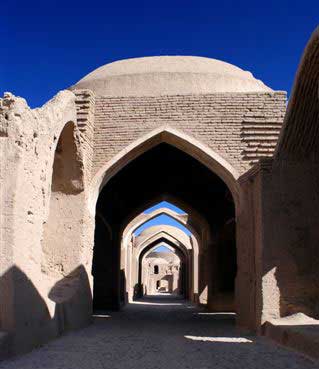
This building structure derives its name from the four earrings that are constructed at the four corners of a rectangular building at the spring level of dome roof. This structural system was developed due to the lack of of wood and stone. It was widely constructed more than 3 thousand years ago, after the invention of the dome-roof structures in the Old Persian Empire (Ashkanian & Sasanian). The main problem with the dome-roof building was to transform the rectangular or polygonal plan of the group of walls into the circular plan at the spring level of dome roof. They used to construct the first row of dome and then construct another row on top of previous one with a little offset closer to the center of the dome circle and so on. That was too difficult to construct. This system was invented to resolve this problem. In this system, once the walls were constructed, four earrings (shekanj) built upon four corners of walls intersections, and then it was much easier to build a dome over these. It is an ideal system to resist vertical and gravity loads and transform them into horizontal and shear loads. For lateral loads, domes behave like trusses and distribute the load to the other parts of the structure creating a perfect load path.

HTML | PDF

Report # 117 : Four arches (Char taaqi) with dome-roof structures, and unreinforced brick and adobe materials.

by Nima T. Bekloo

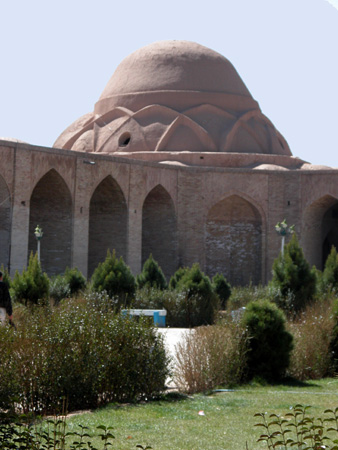
The ‘Four arches’ or Char Taaqi (in Persian) derives its name from the four arches that connects tops of four timber or masonry piers enclosing the space. It is an equilateral architectural unit consisting of four arches or short Barrel vaults between four corner piers, with a dome over the central square; this square and the lateral bays under the arches or barrel vaults together constitute a room of cruciform ground plan. This structural system developed about 2500 years ago, after earring system in the Old Persian Empire (Sasanian age). Main goal of this building system was to create wide openings at four side of the structure. This building system was used for special places that carry high population like fire temple (place where Persians worshiped the Fire God), mosque, bazaar and other public places. This is not that difficult to built a dome over four arches. Further, dome structures are ideal for large span structures against gravity loads as it transforms them into horizontal and shear loads. In addition, for lateral loads, domes behave like a truss and distribute the load to other parts of the structure developing a perfect load path. This construction system has been considered, the most prominent structural system in traditional Iranian architecture. These are basically monumental buildings developed close to desert where there was not enough construction materials that could take tensile stresses.

HTML | PDF

Report # 156 : Typical Single-Story Residential Construction Practices in Trinidad and Tobago

by Richard P. Clarke, Rakesh Ramnath

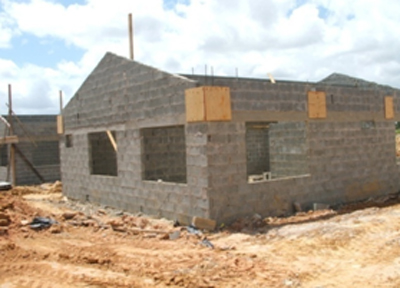
Typical single-story residential construction in Trinidad and Tobago comprises 100 mm thick unreinforced clay tile or concrete block masonry (URM) load-bearing walls supporting the roof. The roofing is a 20 to 30 degree gable or hipped shape and is of approximately 0.2 to 0.5 kN/m2 in weight. It comprises galvanized steel sheets supported by timber laths or cold-formed steel Z-purlins, in turn supported by timber or structural steel rafters. The rafters are nailed or bolted to the top of the walls, without blocking between the rafters. The flexible roof cannot act as a diaphragm. The soil class ranges from IBC classes B to E. Given the significant seismic hazard for Trinidad and Tobago, (i.e. rock PGA in the range of 0.2g to 0.6g for 10% exceedance probability in 50 years), this form of residential construction is quite vulnerable.

HTML | PDF

Report # 116 : Timber Frame Brick House with Attic

by Amit Kumar, Jeewan Pundit

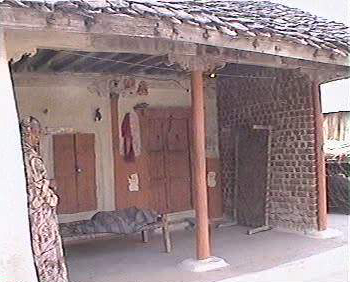
This type of house is used for residential purposes. The building type under study has been picked the from central part of India (Madhya Pradesh), but it is found throughout India with small or large variations. Timber is primarily used for the frame structural elements but due to an acute shortage of timber, this construction type is not practiced anymore. Various components of the building change from place to place depending on climate, socio-economic conditions, availability of material, etc. Timber frames, placed in longitudinal and traverse directions, are filled with brick masonry walls. The floor structure is made of timber planks. Most of the buildings are found to be rectangular in shape with few openings. The roofing material is usually light when it is made from galvanized iron sheets. Seismic performance of a perfectly framed building is very satisfactory. Existing old structures, however, require maintenance and strengthening (Figure-1a,1b). It has been observed that nominal cost will be incurred for introducing earthquake resistant features.

HTML | PDF

Report # 112 : Unreinforced brick masonry residential building

by Qaisar Ali

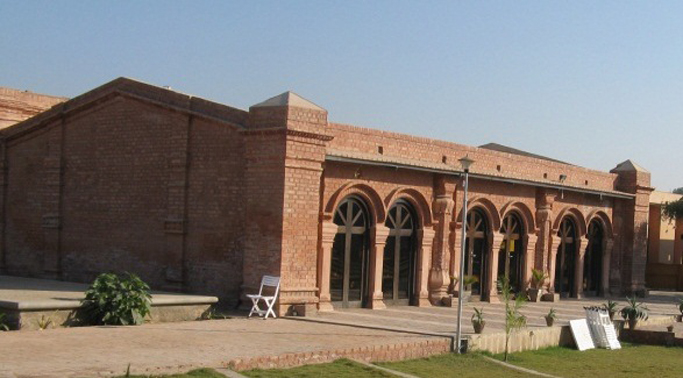
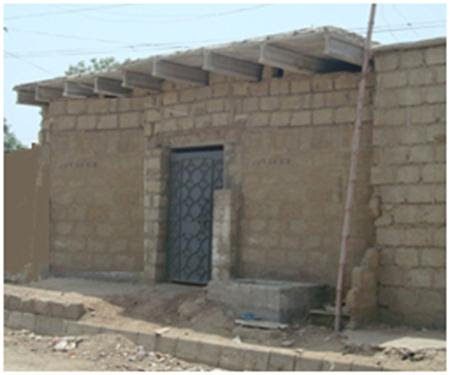
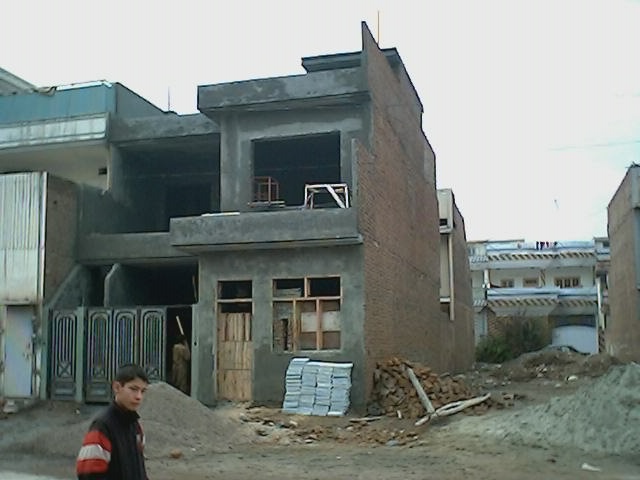
In Peshawar and adjoining areas (in northern Pakistan), the most popular residential construction is a single- or double-story unreinforced masonry building with 9-inch-thick, solid burnt-brick walls and a 5- to 6-inch reinforced-concrete roof slab. Sometimes, however, 4.5-inch solid brick walls are also used as load-bearing walls. The layout of these dwellings is usually regular, mostly rectangular, having horizontal dimensions in the range of 30 ft x 60 ft or 60 ft x 90 ft, etc. Building height rarely exceeds 35 ft. Wall connections at the corners are achieved through proper toothing. Lintels, approximately 6- to 9-inches deep, with a width equal to the wall thickness, are provided above openings. In a relatively engineered construction, however, the lintel beam runs throughout the perimeter. Similar residential buildings are also found in other cities of Pakistan, for example, in Islamabad and Lahore. In Karachi, Pakistan’s largest city, concrete frame structures with concrete-block infill walls are most often used.

HTML | PDF

Report # 99 : Traditional Nawari house in Kathmandu Valley

by Dina D’Ayala, Samanta S. R. Bajracharya

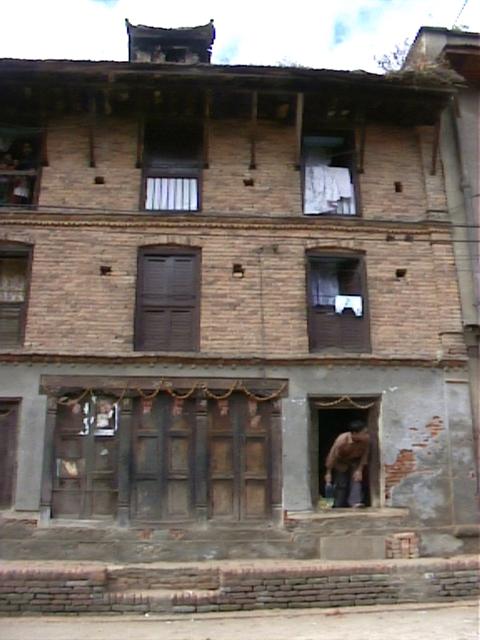
The traditional newari house is usually of rectangular plan shape and developed over three storeys. The depth of the plan is usually about six metres with façades of various widths but most commonly between 4 to 8 metres (see also Korn 1976, and NSET-Nepal 2000). The organisation of the house is usually vertical, over 3 storeys, with a spine wall running through the height, creating front and back rooms. At the upper storey the spine wall is sometimes replaced by a timber frame system so as to create a larger continuous space. The staircase is usually a single flight to one side of the plan. The typical interstorey height is quite modest, between 2.20 and 2.50 m., including the floor structure. The bathroom, where present, is found at ground floor, while the kitchen is on the top floor, usually directly under the roof. The first floor is traditionally used as bedrooms, while the second floor is used as living room and for visitors’ reception. There are essentially two types of clusters of houses, either in long arrays, or around a court or chauk . In some cases the two types of clusters are adjacent with some units in common. In the arrays each house has front and back façade free. The construction of each unit is usually independent so that the facades are not continuum over party walls but each unit forms a separate cell. In such cases connection between façades and sidewalls are usually very good. The most interesting characteristic of these buildings both from an architectural and seismic point of view is the presence of the timber frame. Usually at ground floor, on the facade, to provide an open space for workshops or shops. It is also found internally at the upper storeys. In some cases the masonry only forms the outer shell while the internal structure is all made of timber elements. In the better built example of this typology there are a number of construction details, usually made of timber, which, coupled with the brick masonry walls, substantially improve the seismic performance of the overall structure. These features are best preserved in older examples. Currently these buildings are substantially being altered by use of western materials and technology, typically adding concrete frames as upper storeys. This type of intervention highly increases the vulnerability of the existing buildings.

HTML | PDF

Report # 91 : Single-storey brick masonry house (EMSB1)

by Mehedi Ansary

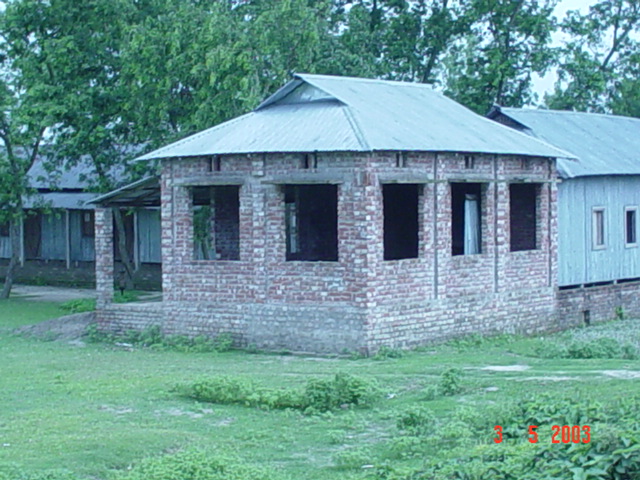
This is a one-story brick masonry house of fired bricks with cement or lime mortar; roof is either GI sheet or another material. These houses can be seen throughout Bangladesh. During the 1918 Srimangal, 1930 Dhubri, and other recent earthquakes, this type of housing suffered heavy damage. Houses with a continuous lintel suffered less.

HTML | PDF

Report # 85 : One family one storey house, also called “wagon house”

by Maria D. Bostenaru, Ilie Sandu

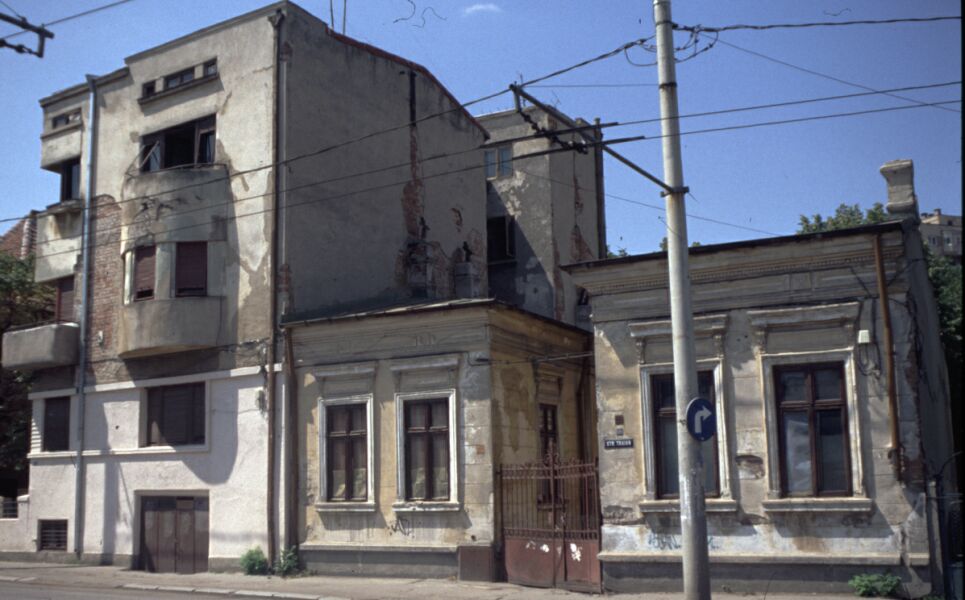
This is one of the oldest housing types in Romania with a statistically significant number of buildings in existence. The overwhelming majority of residential buildings in Romania have been built after 1850. Today. only churches remain from the previous “post-Byzantine” period. Issues relating to the age of historical buildings of cultural value are also discussed within the report. This urban housing type is particularly common in Romanian towns, especially in the southern part of the country, such as in the former Wallachia. It is a middle-class family house constructed from the end of the 19th century until the Second World War. The houses were designed to be semidetached, but have been constructed individually. Thus, in most of cases, the adjacent building, separated structurally, is a totally different construction type, The design of this housing is astonishingly homogeneous, especially considering the relatively lengthy time span the construction has been practiced. The single-unit housing is generally characterized by a rectangular, elongated-shape plan, with an entrance on the long side. The load-bearing system consists of two longitudinal unconfined brick masonry walls and several transversal unconfined brick walls, usually 28 cm thick, which form a wagon-like arrangement — hence the name of this building type. The horizontal structural system is made out of wood plates and joists separated by a distance of 0.70 m. Buildings of this type have been affected by damaging earthquakes in November 1940 and in March 1977, and by two earthquakes of lower magnitudes in 1986 and 1990. They performed well except for the occurrence of some minor cracking in the plaster.

HTML | PDF

Report # 84 : A single-family, two-storey house with brick walls and timber floors

by Maria D. Bostenaru, Ilie Sandu

This type of urban housing was constructed in Romania in the 1930s as single-family housing for the middle class. Typical buildings described in this report are one- or two-story buildings with load-bearing masonry walls. These buildings called “vila” in Romania are characterized by a rectangular plan and are usually semidetached; they share a common wall with the adjacent building. A great variety of buildings exist of this structural type. The building type described in this report has load-bearing brick masonry walls constructed of mud mortar. The floor structure consists of timber planks and joists. These buildings are located in an area well-known to be earthquake-prone. The epicenter is located close to Vrancea and earthquakes exceeding magnitude 7.0 on the Richter scale recur every 30 to 35 years. The latest earthquake of this severity was the March 1977 Vrancea earthquake (M 7.2). However, the building type described in this report is located in the Bucharest area and although affected by the November 1940 Naruja (Vrancea) earthquake (M 7.4), it usually performed well during the 1940 and 1977 earthquakes. The most common type of damage was in the form of cracks and falling chimneys. Some of the older buildings of this type have been affected by other past earthquakes. Because this construction is common for many Romanian buildings of the “Brâncovenesc” architectural style, new retrofit techniques have been developed in recent years (in addition to the techniques used after the 1977 earthquake).

HTML | PDF

Report # 73 : Unreinforced Brick Masonry Apartment Building

by Marjana Lutman, Miha Tomazevic

This construction was commonly used for residential buildings in all Slovenian towns, and it constitutes up to 30% of the entire housing stock in Slovenia. The majority of these buildings were built between 1920 and 1965. They are generally medium-rise, usually 4 to 6 stories high. The walls are unreinforced brick masonry construction laid in lime/cement mortar. In some cases, the wall density in the longitudinal direction is significantly smaller than in the transverse direction. In pre-1950 construction, there are mainly wooden floor structures without RC tie-beams. In post-1950s construction, there are concrete floors with RC bond-beams provided in the structural walls. Roof structures are either made of wood (pitched roofs) or reinforced concrete (flat roofs). Since this construction was widely practiced prior to the development of the seismic code (the first such code was issued in 1964), many buildings of this type exceed the allowable number of stories permitted by the current seismic code (maximum 2 or 3 stories for unreinforced masonry construction). Buildings of this type have been exposed to earthquake effects in Slovenia. However, this construction type experienced the most significant damage in the 1963 Skopje, Macedonia, earthquake, which severely damaged or caused the collapse of many buildings.

HTML | PDF