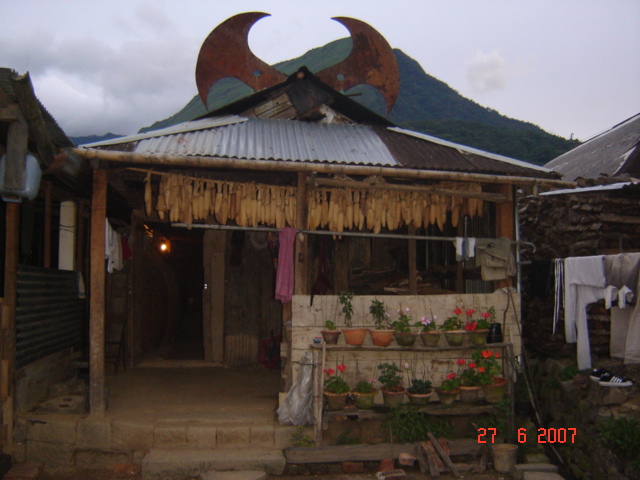
Report # 147 : Traditional Naga Type House

by Amir Ali Khan

The housing type is most common throughout the Northeast India which lies in the most severe seismic zone of the country (Zone V – corresponding to MSK IX). Majority of this type of houses are used for residential purposes. Typically these houses are built with light weight locally available material like bamboo, wooden planks, thatch etc. These housing types have traditional system of bamboo/wooden posts. Bamboo posts are inserted into the ground to act as compression members and are tied with horizontal bamboo/wooden girders with the help of bamboo ropes (cane) to give a proper shape and framing action. However, there is no protection of bamboo/wooden posts against decaying/termites or any other natural cause. The performance of these houses during the past earthquakes is unknown. However, during the discussions with local people about the performance of these houses in the past major earthquakes, it was noted that the majority of houses survived.

HTML | PDF

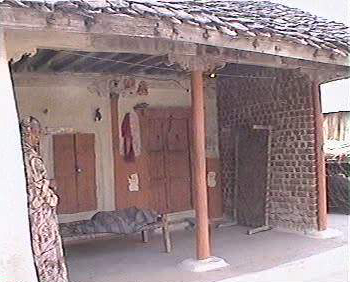
Report # 116 : Timber Frame Brick House with Attic

by Amit Kumar, Jeewan Pundit

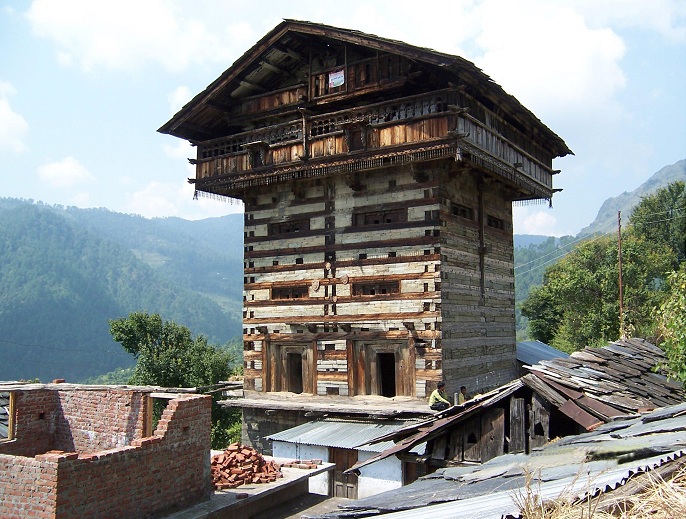
This type of house is used for residential purposes. The building type under study has been picked the from central part of India (Madhya Pradesh), but it is found throughout India with small or large variations. Timber is primarily used for the frame structural elements but due to an acute shortage of timber, this construction type is not practiced anymore. Various components of the building change from place to place depending on climate, socio-economic conditions, availability of material, etc. Timber frames, placed in longitudinal and traverse directions, are filled with brick masonry walls. The floor structure is made of timber planks. Most of the buildings are found to be rectangular in shape with few openings. The roofing material is usually light when it is made from galvanized iron sheets. Seismic performance of a perfectly framed building is very satisfactory. Existing old structures, however, require maintenance and strengthening (Figure-1a,1b). It has been observed that nominal cost will be incurred for introducing earthquake resistant features.

HTML | PDF

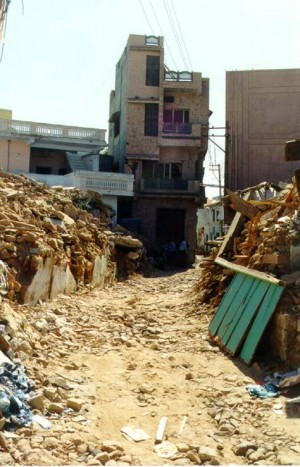
Report # 80 : Low-strength dressed stone masonry buildings

by Ravi Sinha, Vijaya R. Ambati

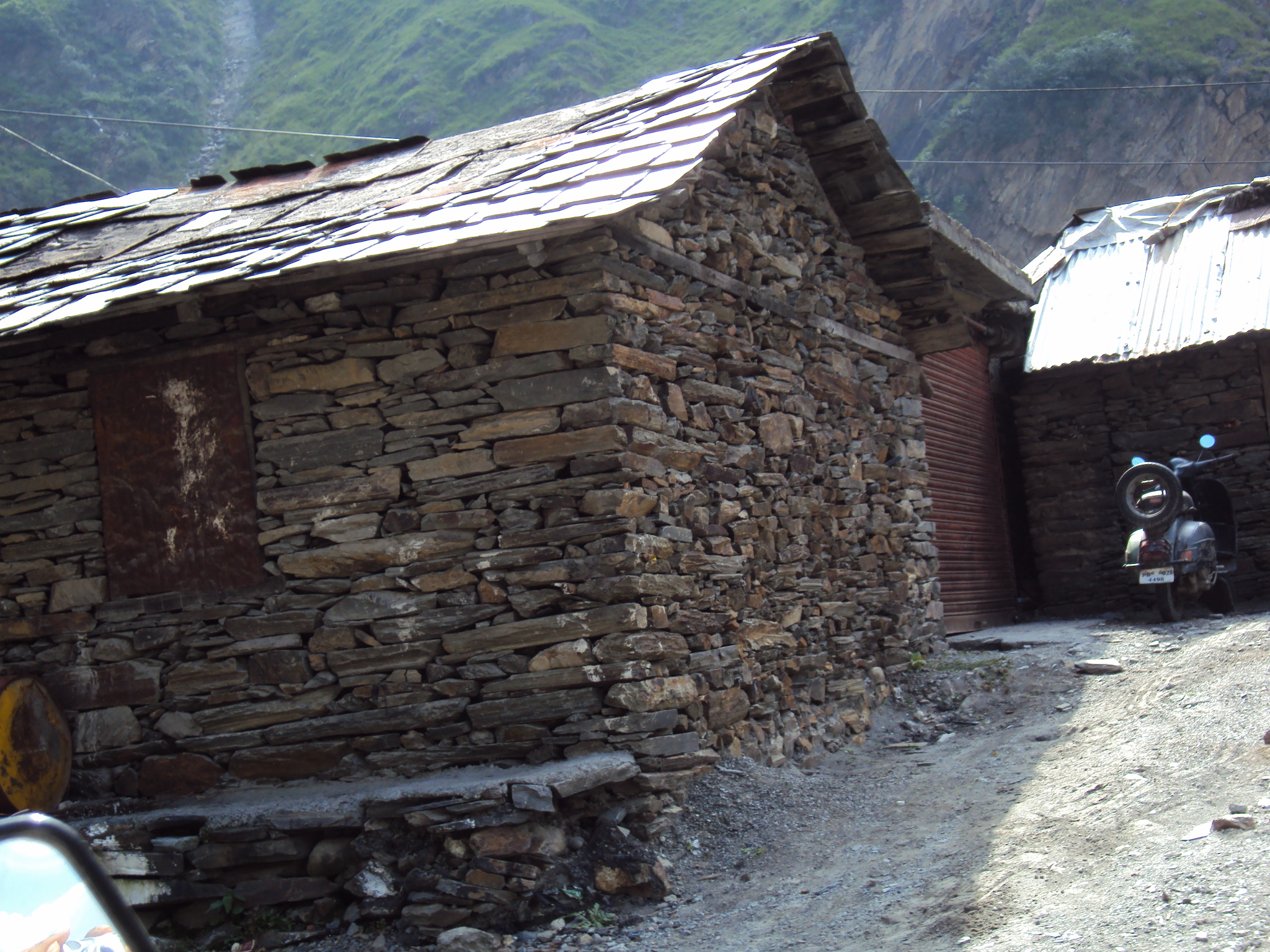
Construction of stone masonry buildings using easily available local materials is a common practice in both urban and rural parts of India. Stone masonry houses are used by the middle class and lower middle class people in urban areas, and by all classes in rural areas. In rural areas, these buildings are generally smaller in size and are used as single-story, single-family housing. In urban areas, these buildings are up to 4 stories high and are used for multifamily housing. This is a typical load-bearing construction, in which both gravity and lateral loads are resisted by the walls supported by strip footing. If the locally available stone is soft, dressed (shaped) stones are commonly used and can be chiselled at low- or moderate cost. Mud or lime mortar has been used in traditional constructions; however, more recently, cement mortar is being increasingly used. Because soft sandstone is readily available in the Kutch region of Gujarat in the western part of India, stone block masonry constructions are widely used for both single- and multi-story constructions. These houses are usually built by local artisans without formal training and the resulting constructions are structurally weak and incapable of resisting large seismic forces. In the Kutch region, which was affected by the 2001 Bhuj earthquake, this construction type is commonly used with a gable end timber roof truss or RCC roof slabs. Thousands of these houses collapsed in the 2001 Bhuj earthquake resulting in the deaths of large numbers of people. This construction type is inherently unsuitable for areas of moderate-to-high seismic hazard, such as the Kutch region of Gujarat.

HTML | PDF

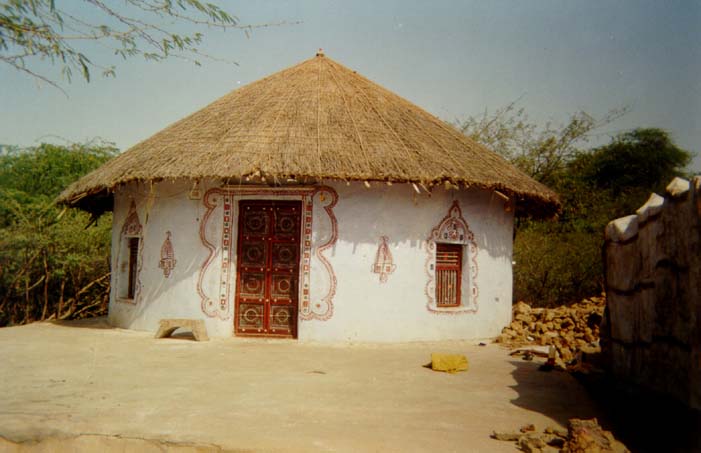
Report # 72 : Traditional rural house in Kutch region of India (bhonga)

by Madhusudan Choudhary, Kishor S. Jaiswal, Ravi Sinha

The Bhonga is a traditional construction type in the Kutch district of the Gujarat state in India, which has a very high earthquake risk. A Bhonga consists of a single cylindrically shaped room. The Bhonga has a conical roof supported by cylindrical walls. Bhonga construction has existed for several hundred years. This type of house is quite durable and appropriate for prevalent desert conditions. Due to its robustness against natural hazards as well as its pleasant aesthetics, this housing is also known as “Architecture without Architects.” It performed very well in the recent M7.6 Bhuj earthquake in 2001. Very few Bhongas experienced significant damage in the epicentral region, and the damage that did occur can be mainly attributed to poor quality of the construction materials or improper maintenance of the structure. It has also been observed that the failure of Bhongas in the last earthquake caused very few injuries to the occupants due to the type of collapse.

HTML | PDF

Report # 23 : Rural mud house with pitched roof

by Amit Kumar

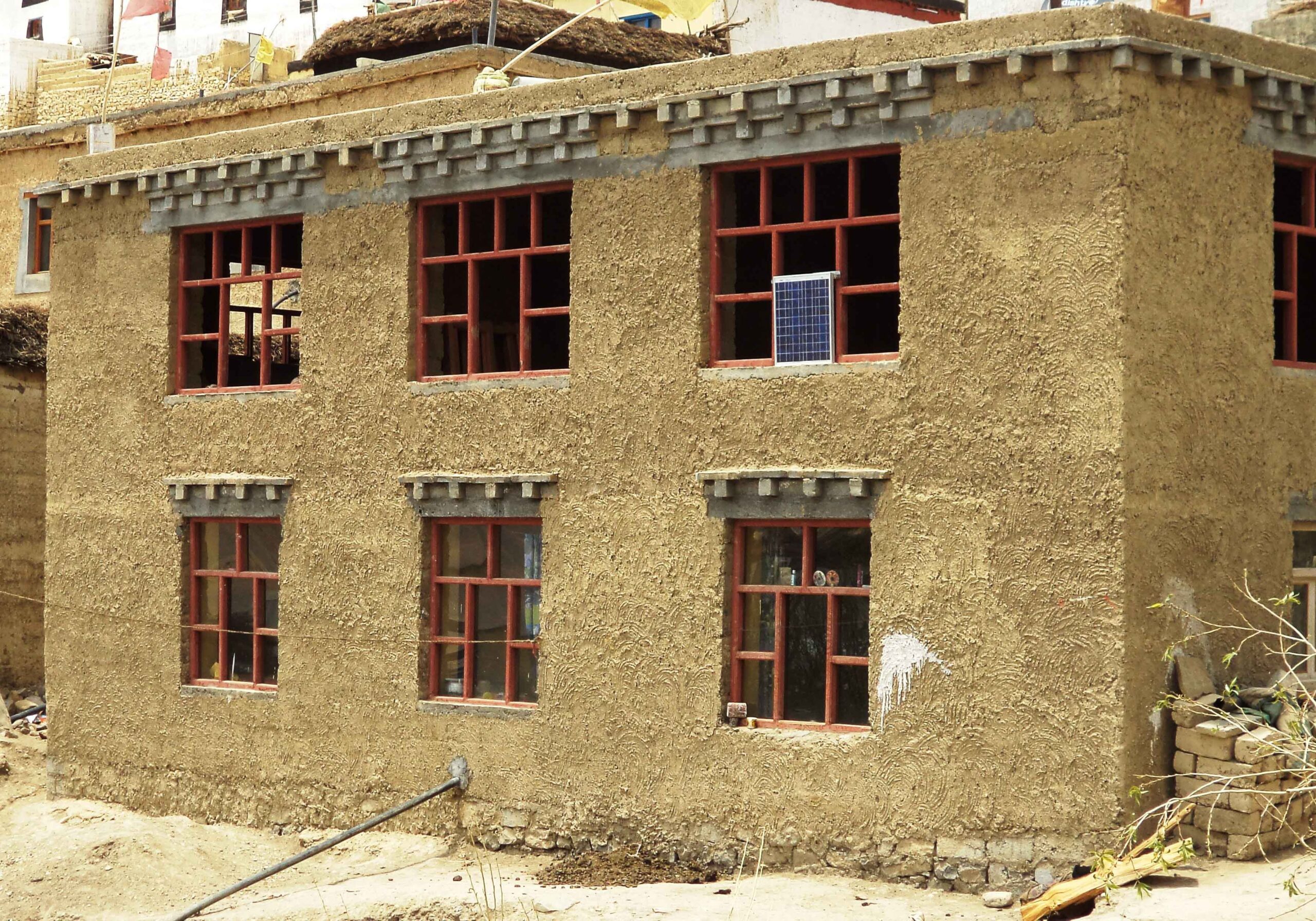
This is a typical rural construction found throughout India, except in the high rainfall areas in the northeastern part of the country. It is a single-family house, mainly occupied by the poorer segment of the population. The main load-bearing system consists of mud walls, which carry the roof load. In some cases wooden posts are provided at the wall corners and at intermediate locations. The wooden posts and walls are not structurally integrated, and therefore the loads are shared by the walls and the frame. There are very few openings (doors and windows) in these buildings. In rural areas there are usually no windows at all. In general, this type of construction is built by the owners and local unskilled masons and the craftsmanship is very poor. This building type is classified as grade-A (most vulnerable) per the IAEE building classification and IS Code 1893:1984. This is a low-strength masonry construction and it is considered extremely vulnerable to seismic forces.

HTML | PDF

Report # 22 : Unreinforced brick masonry walls with pitched clay tile roof

by Amit Kumar

This is a traditional construction practice followed in India for centuries. Buildings of this construction type are used for residential, commercial, and public purposes throughout India, especially in the northern and central parts, where good quality soil for brick production is widely available. This is a single-story construction used both in rural and urban areas. The walls are constructed using clay bricks laid in mud, brick-lime or cement/sand mortar. The roof does not behave as a rigid diaphragm. These buildings are built without any seismic provisions and are considered to be moderately-to-highly vulnerable to earthquake effects.

HTML | PDF

Report # 21 : Unreinforced brick masonry building with reinforced concrete roof slab

by Ravi Sinha, Svetlana N. Brzev

Typical rural and urban construction in western and southern India. This construction is widely prevalent among the middle-class population in urban areas and has become popular in rural areas in the last 30 years. Brick masonry walls in cement mortar function as the main load-bearing element. The roof structure is a cast-in-situ reinforced concrete slab. If constructed without seismic features, buildings of this type are vulnerable to earthquake effects. They exhibited rather poor performance during the Koyna (1967), Killari (1993), Jabalpur (1997), and Bhuj (2001) earthquakes in India.

HTML | PDF

Report # 20 : Unreinforced brick masonry walls in mud mortar with flat timber roof

by Amir Ali Khan, Khalid Moin

This is a traditional construction practice prevalent both in the urban and rural areas of northern India, particularly in the western part of the Uttar Pardesh state. According to the 1991 Indian census, this construction constitutes about 17% of the total national housing stock and about 31% of the U.P. housing stock. Typically, this is a single-story construction. The main load-bearing elements are unreinforced brick masonry walls in mud mortar built without any seismic provisions. The roof structure consists of timber beams supported by the walls. Clay tiles or bricks are laid atop the beams; finally, mud overlay is placed on top of the tiles for the thermal protection and to prevent leakage. The main seismic deficiencies are heavy roofs and low-strength masonry walls, which render the building rather vulnerable to seismic effects.

HTML | PDF

Report # 19 : Reinforced concrete frame building with masonry infill walls designed for gravity loads

by Kishor S. Jaiswal, Ravi Sinha, Alok Goyal

The construction of reinforced concrete buildings with brick masonry infill walls has been a very common practice in urban India for the last 25 years. Most of this construction has been designed for gravity loads only, in violation of the Code of Indian Standards for earthquake-resistant design. These buildings performed very poorly during the Bhuj earthquake of January 2001 and several thousand buildings collapsed. The collapse was not limited to the epicentral region. The seismic vulnerability of this construction is clearly demonstrated by the collapse of about 75 RCC frame buildings and damage to several thousand others in and around Ahmedabad, which is over 250 km from the epicenter.

HTML | PDF

Report # 18 : Rubble stone masonry walls with timber frame and timber roof

by Svetlana N. Brzev, Marjorie Greene, Ravi Sinha

This typical rural construction in central, southern, and northern India houses millions of people. It is cheap to construct using field stones and boulders, but extremely vulnerable in earthquakes because of its heavy roofs and poorly constructed walls. The load-bearing structure is a traditional timber frame system, known as ‘khan’. It is a complete frame with timber posts spanned at about 2.6 m. Thick stone walls (typical thickness 600 mm – 1.2 m) provide enclosure and partial support to the roof. Walls are either supported by strip footings of uncoursed rubble masonry or are without any footings at all. The roof structure consists of timber planks and joists. To help keep the interiors cooler during hot summer months (peak temperatures exceeding 40°C.), a 500-800 mm thick mud overlay covers the top the roof. This construction type is considered to be very vulnerable to earthquake effects. Many buildings of this type were damaged or collapsed in the 1993 Killari (Maharashtra) earthquake (M 6.4) with over 8,000 deaths.

HTML | PDF